Tuesday, 13 June 2017

SUPPLY CHAIN MALAYSIA: Official WEBSITE for SCM Course


It's OFFICIAL!


CLICK the image below to go to our Website!


Tuesday, 6 June 2017

SUPPLY CHAIN MALAYSIA: E-Procurement and You


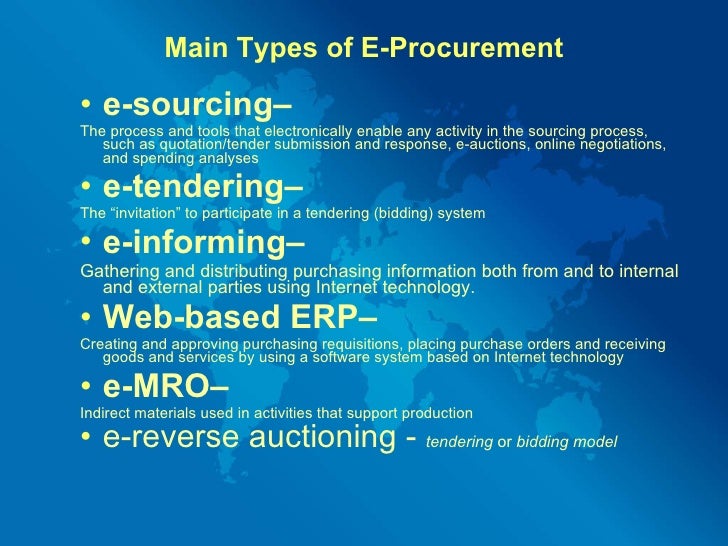
E-procurement (electronic procurement, sometimes also known as supplier exchange) is the business-to-business or business-to-consumer or business-to-government purchase and sale of supplies, work, and services through the Internet as well as other information and networking systems, such as electronic data interchange.

Image result for types of e-procurement


Four types of P2P integrations areas where eProcurement or other frontline buying systems are integrated in real-time:
  • The first (and most common) is integration into core ERP/MRP environments focused on core financials and inventory. We should note that rarely is any financials integration "vanilla," even in the case of standard ERP/MRP integration, which often forms the connectivity between front line buying and procurement activity and IT/ finance systems. Even in this area, typical fields that organizations map for integrations are often highly dependent on the specific ERP and business application packages they are integrating with (e.g., GL coding structure). Moreover, the degree to which the underlying financials system is set up from a financial accounting, corporate governance and managerial accounting will dictate the level of ideal integration required for P2P.
  • The second is focused on procurement related integrations into a range of toolsets. These may include vendor management systems (VMS), software monitoring/metering/licensing applications, T&E and travel tools, contract management systems, supplier management applications and e-invoicing/AP automation tools.
  • The third is to more generalized business applications outside of procurement that are relatively similar across industries. This can include CRM, HR, specialized inventory, warehouse management, asset management, claims/warranty and related toolsets.
  • The fourth is industry-specific, such as in retail/point-of-sale (POS) systems. Other examples include contract management and e-invoicing capabilities necessary in environments such as oil and gas, where a $200 million PO might have a single-line item: "drill an offshore well."

E-Procurement is very technical hence formal learning is encouraged. 
Get step by step guide from our experienced trainers; 

E- Procurement
7-8 October 2017


Article extracted from Spend Matters

========================================================================

Click here for more info in SUPPLY CHAIN MANAGEMENT COURSE

Feel free to contact us to find out more about our specialty in Supply Chain Management Program

03 -2106 5431 (Idati/ Afiqah) 
03- 7722 5927 (Fadzlina / Amalina)


SUPPLY CHAIN MALAYSIA: The Importance of Supply Strategy


Companies today generally carry smaller inventories in a bid to stay lean, and any disruption to supply can make planning more challenging than ever.

Image result for importance in developing supply strategy


Thus, developing a strategy to ensure supply chain resilience and protecting against foreseen events – such as adverse weather, a major fire or failure of IT systems – is key to keeping shortages or disruptions to a minimum.
“Unfortunately, there is no one-size-fits-all solution,” said Alan Ross, Senior Strategic Risk Management Consultant, Risk Engineering, at Zurich.


“One issue we have often found when looking at a company’s tier two suppliers, is that further back in the supply chain they all rely on the same supplier,” said Alan.
“This means that while you might think you’ve got three alternative suppliers should anything go wrong, in reality they may all rely on the same supplier at some point in the chain. And depending on the supply you need it can take weeks or months getting an alternative supply chain up and running.”

Putting plans in place

Having a supply chain strategy that looks outwards, as well as inwards, can also mitigate risks. So, a company should not solely rely on its own business continuity arrangements, but also have a solid understanding of its key suppliers’ plans as well.


Ready to be guided in Planning your Strategy? Sign up in our course:

Specifying Requirement & Planning Supply
2-3 August 2017


Analysing Supply Market
16-17 August 2017


Developing Supply Strategy
13-14 Sept 2017


Article extracted from Zurich


========================================================================

Click here for more info in SUPPLY CHAIN MANAGEMENT COURSE

Feel free to contact us to find out more about our specialty in Supply Chain Management Program

03 -2106 5431 (Idati/ Afiqah) 
03- 7722 5927 (Fadzlina / Amalina)

SUPPLY CHAIN MALAYSIA: The Bonds between Logistics and Supply Chain


" We are logistic company not related to Supply Chain."


So here is ' Simplified version' for each time we explained to them on how does logistics connected to Supply Chain Management.

According to Sanjeev Bagal, there are obvious differences between Logistics Management and Supply Chain Management.


Key Differences between Logistics and Supply Chain Management

The following are the major differences between logistics and supply chain management:

- The flow and storage of goods inside and outside the firm is known as Logistics. 
- The movement and integration of supply chain activities is known as Supply Chain Management.
- The main aim of Logistics is full customer satisfaction. Conversely, the main aim behind Supply chain - Management is to gain substantial competitive advantage.
- There is only one organization involved in Logistics while a number of organizations are involved in Supply Chain Management.
- Supply Chain Management is a new concept as compared to Logistics.
- Logistics is only an activity of Supply Chain Management.


However, Mr Sanjeev agrees that Supply Chain Management and Logistics are inseparable. Hence do not contradict them but supplement each other. SCM helps Logistics to be in touch with the transportation, storage and distribution team.


To know more about the relations between Logistics and Supply Chain Management, dig up in our upcoming course:

Managing Logistics in the Supply Chain 
28- 29 August 2017


Articles extracted from Sanjeev Bagal.

========================================================================
Click here for more info in SUPPLY CHAIN MANAGEMENT COURSE

Feel free to contact us to find out more about our specialty in Supply Chain Management Program

03 -2106 5431 (Idati/ Afiqah) 
03- 7722 5927 (Fadzlina / Amalina)

Thursday, 1 June 2017

SUPPLY CHAIN MALAYSIA: Be Success in Selecting Supplier in just 5 Steps


Every company or every business HAVE Supply Chain. Even a small grocery store have Supply Chain. But they just do not realize it. No matter the business is about selling products or services, they still need to find their supplier, select the best one AFTER they Successfully specify their requirements and planning supply.

Ally Conrad, an Event Manager have listed 5 Steps to be successful in selecting supplier. Let see what she had in her mind shall we?


1) Supplier Selection Scorecard

- The supplier selection scorecard contains all the important elements you require in a supplier. It has long been stated, “That which does not get measured, does not get done”.


Learn this to match with Malaysian culture in our upcoming course:
Specifying Requirements & Planning Supply
2-3 Aug 2017


2) Identify Suitable Supplier


- Create the pool from which you will select a supplier. During this part of the process you will want to consider:

Current suppliers – Starting with suppliers you have experience with and established relationships is generally a good idea.
Past suppliers – Depending upon the reasons why they are ‘past’ and not ‘current.’
Competitors – You may be in a position to buy from a competitor if it is ethical and low-risk.
Industry groups – many of which are non-profit and maintain data bases of member companies.
Recommendations and prior business relationships – perhaps created while working at other companies.
Internet – which offers myriad opportunities to find, research, and contact potential suppliers.

Learn this intensely in our course:
Appraising & Short- Listing Suppliers
30 Sept- 1 Oct 2017


3) Scorecard Ranking

Tabulate the information you collect and use the scorecard to rank the potential suppliers.

Depending upon the complexity and/or criticality of the product or service, you may:

Select the highest ranking supplier – Recognize that while you are not required to pick the top scorer, moving too far down the list is a red flag, indicating the process was flawed.
Choose more than one for further qualification – May include interviews, site visits, etc.


Take away the knowledge in our upcoming course:
Obtaining & Selecting Offers
21- 22 Oct 2017


4) Negotiate
After you have narrowed the list to a manageable number of best options, possibly even one, let the negotiations begin!

Depending on the critical good or service, you may negotiate with just the top supplier on your scorecard, even if others remain on the list of potentials.Sure, to negotiate is not easy.

Learn the art of negotiating offers in our course:
Negotiating Offers
28-29 Oct 2017


5) Create Contract and Activate Purchasing System
Once an agreement has been reached, a contract is signed. Again, depending upon complexity, lawyers may be involved. For simpler transactions, the Purchase Order is the contract.


How to lower the cost while purchasing? Get it right in:
Group Purchasing Course
9-10 Sept 2017


The last step is to activate your procurement system.

Are you on the right track for procurement? Get to know in:
Environmental Procurement
12-13 Aug 2017

E-Procurement
7-8 Oct 2017


Articles extracted from Ally Conrad

========================================================================